Commercial truth
Buyer/account identity, opportunity, commercial stage, relationship context and selected commitments.
02 / OPERATIONS — DIGITAL OPERATIONS
Connect the work between inquiry, CRM and delivery—not just the software between them.
SERVICE SOLUTION SHOWCASE
A service-team operating model for clearer records, ownership, approvals, handoffs and exception visibility across the tools the business already uses.
01 / THE OPERATING GAP
An inquiry in an inbox. A promise in CRM. A task in a separate tool. A decision in a message. The work crosses systems; authority, ownership and context may not travel with it.
The same tools. An unclear path: each gap leaves someone reconstructing what happened.
An inquiry exists. Who reviews it?
Scope sits in an inbox. Which version counts?
Everyone is copied. Who is accountable?
A task exists. Is work ready to begin?
Approval is pending. Who decides?
The task closed. Did the work meet the condition?
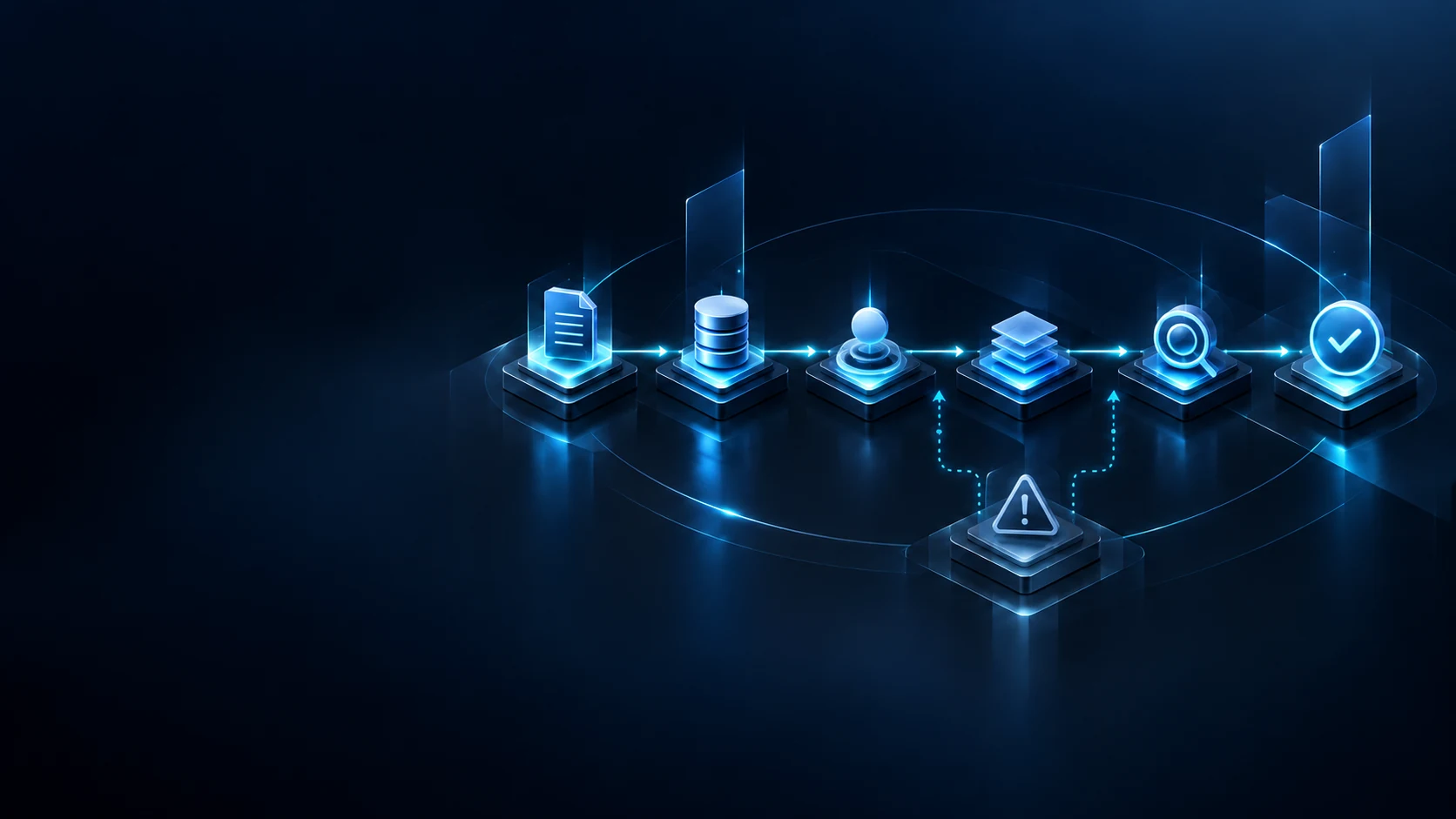
Illustrative operating model. Scroll to see the path align, or select either view. No live CRM records or integrations are represented.
THE OPERATING MODEL
Requests can move through records, ownership, delivery and review while each important state remains accountable and exceptions stay visible instead of disappearing between systems.
02 / ARCHITECTURE BEFORE INTEGRATION
before synchronization
before automation
before reporting
before integration
before scale
Define what is true, who is accountable and what happens next. Then decide where tools support that model. Digital Operations makes sense without AI; automation or AI may support appropriate work when justified.
03 / SOURCE-OF-TRUTH RULES
For every important condition, the business should know which system answers “what is true?” One coordinated operating flow can span several authoritative systems.
For commercial pipeline, sales ownership and follow-up, explore CRM & Sales Operations ↗. This showcase continues into cross-functional operations and delivery.
04 / SALES → DELIVERY
A handoff is complete when the receiving owner has the required context and accepts the next responsibility. Explore what happens when the start condition is missing.
THE CONTEXT THAT TRAVELS
A notification being sent does not prove that the handoff completed.
ILLUSTRATIVE HANDOFF / RECOVERY SEQUENCE
Commercial owner → delivery owner
The accepted scope and commitments are ready for review. Responsibility remains with the sending owner until the receiving owner accepts.
Missing owners, conflicting state, blocked approvals, failed handoffs and unavailable dependencies need a visible recovery path.
05 / DELIBERATE CONNECTIONS
An engagement may repair a process, reconfigure an existing CRM, connect selected systems, simplify the stack or replace a dependency. Architecture decides; tools are connected only where the operating model requires them.
Integration scope, APIs, permissions, compatibility and technical constraints are verified during an actual project. “Hub” describes an operating concept; Batisha Labs is not presenting a proprietary CRM or SaaS platform.
OPERATIONAL VISIBILITY
A management view should reflect operating state and reveal decisions that need an owner.
06 / PROPOSED DELIVERABLES
A practical specification of how the operation should work, before deciding what to build or connect. These are potential outputs; final scope is defined in the proposal.
Actors, systems, states, approvals, handoffs and exceptions—showing where responsibility or context currently breaks.
Commercial stages, downstream delivery states and their transition rules, without forcing every operation into CRM.
Entry points, record creation, ownership, routing, context transfer, acceptance conditions and exception behavior before integrations are built.
The states operators need to see, where truth lives, how exceptions recover and what the client needs to maintain the design safely.
EVIDENCE BOUNDARY
This page shows a proposed operating architecture based on the Digital Operations offering. It is not a client case study and does not claim a deployed CRM integration, customer usage, time saved, error reduction, faster delivery or other measured performance result.
It makes the service approach concrete. A real engagement starts with your systems, constraints and operating problem.
BRING THE WORKFLOW. WE START WITH THE WORK.
Bring the current flow, the systems it crosses and where ownership or state becomes unclear. We can scope the operating problem before deciding what should be connected, changed or automated.