
Repeatable. Traceable. Owned.
Recurring work with understandable inputs, sufficiently stable rules, clear ownership and bounded failure is a candidate for assessment.
03 / AUTOMATION — AI AUTOMATION SYSTEMS
Automate the repeated work.
Keep commercial judgment human.
Inbound inquiries often need the same work: check the submission, identify missing context, interpret the request, determine the likely route and prepare the next response.
A controlled workflow can handle suitable parts of that process while keeping consequential customer decisions human.
01 / START WITH THE WORK
Similar submissions, missing information and repeated follow-ups can consume operational attention. The first decision is whether the process is stable, understandable and safe enough to automate.
Use deterministic validation. AI adds no value to a fixed required-field check.
Conceptual treatment, not a live classificationRecurring work with understandable inputs, sufficiently stable rules, clear ownership and bounded failure is a candidate for assessment.
Low volume, shifting rules, poor inputs, unclear owners, heavy exceptions or high consequences without controls may make automation unsuitable.
02 / CRITERIA BEFORE AI
Qualification means organizing an inquiry against approved business criteria so an appropriate next action can be prepared. It does not give AI authority to accept or consequentially reject a prospect.
Business owner approves criteria → workflow encodes stable rules → AI interprets context → human owns consequential judgment.
03 / CONTROLLED LEAD HANDLING
AI lead qualification, routing and follow-up drafting sit inside a workflow defined by the business. External submissions are information to interpret, never instructions that can redefine its behavior.
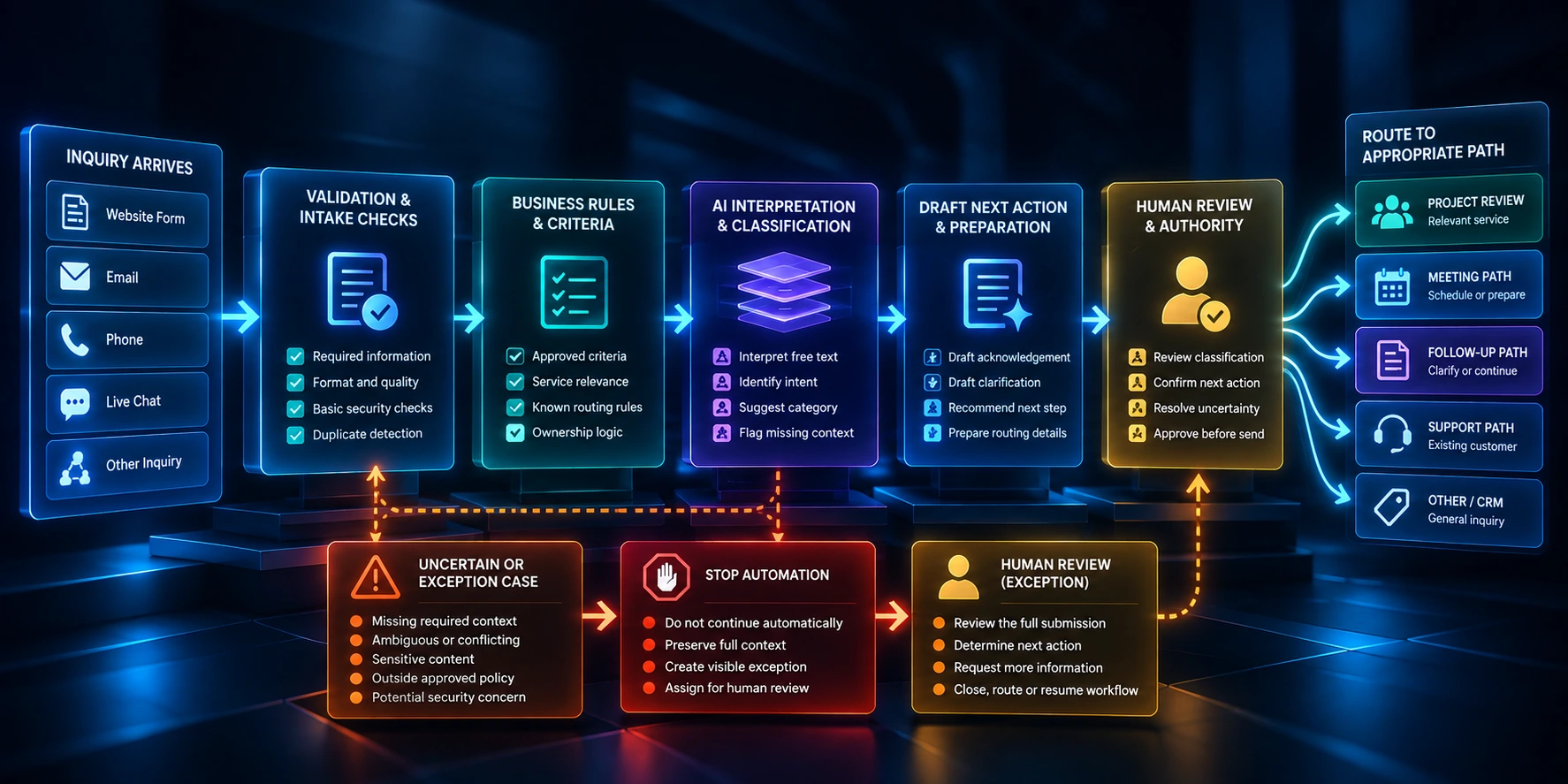
Validation and approved rules come first. AI may interpret and prepare; consequential decisions remain with an authorized person.
Illustrative architecture explorer. No live inquiries, AI processing or connected systems.
Check required fields, normalize known data and detect duplicates. External submission content is data, never permission or a system instruction.
Apply business-owned criteria and known routing logic. AI does not invent qualification policy.
Interpret free text, summarize relevant context and identify missing information within the approved task.
Suggest a service match; preserve the distinction between a suggestion and an approved classification.
Prepare a clarification or follow-up using approved context. Validate it for unsupported commitments before any send path.
Resolve consequential ambiguity, confirm the next action and retain authority over commercial decisions.
Use the authorized route and record the final accepted state. A draft alone cannot authorize sending.
05 / PREPARATION ≠ RELEASE
A generated follow-up remains a draft until the approved workflow authorizes the next action. AI must not invent price, discounts, capacity, scope, delivery dates, contractual terms, acceptance, guarantees or business results.
The draft remains held. It cannot unlock a send path.
Conceptual gate sequence. No message is generated or sent.
Drafting, approval and sending are separate responsibilities.
06 / EXCEPTIONS & RECOVERY
The right response to uncertainty is a visible review state. Never silently guess, hide the failure or retry indefinitely.
Prevent the next automated action.
Request the necessary information before progressing.
Ask an owner to resolve the service or next-action decision.
Hold the workflow and review the permitted handling.
Escalate to a person with sufficient commercial authority.
Reconcile with the existing record under approved rules.
Expose the stopped state; use a bounded retry or approved fallback after review.
07 / TRACEABLE DECISIONS
Keep the original inquiry, AI suggestion, approved classification, responsible owner, next action and final accepted state distinct. A reviewer should be able to see what entered, what was proposed, which route was selected and whether human review occurred.
Keep only the context and evidence the workflow needs. Read our privacy notice ↗
08 / EVALUATE BEFORE EXPANSION
Assess classification agreement, routing correctness, missing-context detection, draft appropriateness, unsupported-commitment avoidance, exception capture and failure behavior.
Review representative cases against approved acceptance criteria before expanding use. Providers and tools follow the requirements.
How we design and validate systems09 / WHAT AN ENGAGEMENT COULD DELIVER
We define the work, its permitted actions and its failure paths before introducing automation. Implementation scope follows the assessment and approved design.
Determine what should be automated, where rules are sufficient, where interpretation helps and where human control remains necessary.
Define inputs, validation, approved categories, routing, uncertainty, ownership, stop conditions and workflow evidence.
Specify permitted context, draft boundaries, required review and the separation between approval and sending.
Define escalation, recovery, traceability, representative tests and the conditions required before broader use.
SERVICE SOLUTION SHOWCASE
This is an illustrative proposed workflow, not a completed customer deployment or a production AI system. No measured lead-quality, response-time, conversion, productivity or revenue improvement is claimed.
START WITH YOUR OPERATING PROBLEM
Bring the current process, the repeated work, the systems involved and the decisions that still need a person.
We can determine whether the next step is better workflow design, deterministic automation, AI assistance—or no automation at all.
Start with high-level context. Keep credentials, private customer records and confidential operational datasets out of the initial brief.
OTHER SYSTEMS, OTHER OPERATING PROBLEMS
Related service contexts: Lead & Revenue Automation · CRM & Sales Operations